Can WHOIS data be hidden? Published: 05 Nov, 2026
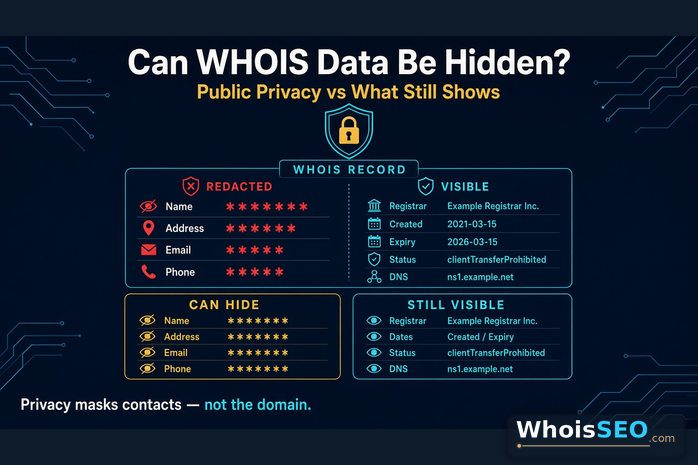
Can WHOIS data be hidden? Yes—for most everyday viewers. Registrar privacy services and registry redaction can keep your name, address, phone, and email out of the public record. What they cannot do is erase the registration itself, hide DNS, or make you unreachable to the registrar, registry, or lawful process.
This guide answers the question in plain language: what you can hide, what still shows up, how privacy differs from GDPR-style redaction, and how to verify any domain with free WHOIS lookup and DNS lookup tools on WhoisSEO. For the product-style overview of privacy add-ons, see what is WHOIS privacy protection?
Quick answer: can WHOIS data be hidden?
Public contact fields can usually be hidden or redacted. Operational fields usually cannot.
| Data type | Can the public see it? | Typical outcome with privacy / redaction |
|---|---|---|
| Registrant name, street address, phone, personal email | Often no | Proxy contacts or “REDACTED FOR PRIVACY” |
| Registrar of record, creation / expiry dates, status flags | Usually yes | Still visible—useful for renewals and risk checks |
| Nameservers and DNS (A, MX, TXT, etc.) | Yes | WHOIS privacy does not hide DNS |
| Underlying contacts on file with the registrar | Not in public WHOIS | Still stored for renewals, abuse, and legal notices |
So the honest answer is: you can hide personal WHOIS data from casual lookups; you cannot make a domain invisible or unaccountable.
What “hiding WHOIS data” actually means
WHOIS (and its modern companion RDAP) is the public registration directory for many TLDs. Historically it listed whoever registered the name. Two common mechanisms changed that:
- WHOIS privacy / proxy — Your registrar (or a privacy provider) publishes their proxy contacts instead of yours. Mail and abuse notices are forwarded under the provider’s rules.
- Registry redaction — Especially after GDPR and similar privacy laws, many registries redact personal fields by default. You may see redaction labels even without buying a separate privacy SKU.
Both reduce public exposure. Neither deletes the domain from the registry database, and neither replaces accurate contacts inside your registrar account.
What you can hide from the public
On many gTLDs (for example .com, .net, .org), enabling privacy or relying on redaction typically conceals:
- Personal name and organization details that would otherwise identify an individual
- Postal address and phone number
- Direct registrant email addresses that scrapers love to harvest
That cut in exposure is why privacy became a default recommendation for personal blogs, side projects, and many small businesses. Less public data means less WHOIS-driven spam and fewer casual doxxing opportunities.
When you shop for a name, privacy is one checkout option among renewals, locks, and DNS. Context: how domains are registered and what is a domain registrar?
What you cannot hide with WHOIS privacy
People often expect privacy to do more than it can. It does not hide:
- That the domain exists — Creation date, expiry, registrar, and status flags usually remain queryable.
- DNS — A/AAAA, MX, NS, CNAME, and TXT stay public. Privacy is not a CDN proxy and not a VPN. Overview: what are DNS records?
- Website identity — About pages, legal footers, payment processors, social profiles, and certificates can still reveal who runs the site.
- Registrar / registry knowledge — Your real contacts stay on file for billing, recovery, and compliance workflows.
- Lawful process — Court orders, UDRP / dispute procedures, and legitimate abuse escalations can compel disclosure or forwarding. Privacy is not a shield for illegal activity.
If your goal is operational security for a brand, combine privacy with registrar 2FA, transfer lock, and careful DNS—not privacy alone.
Privacy vs redaction vs “blank WHOIS”
These terms get mixed up in support tickets:
- Privacy service — Active proxy contacts (provider name, relay email). Looks “owned” by a privacy company in WHOIS.
- Redaction — Fields removed or labeled redacted at the registry layer. May appear without a separate yearly fee.
- Thin WHOIS — Some responses point you to the registrar for full details; public output is intentionally limited.
None of these equal “the domain has no owner.” Someone always holds the registration rights for the paid term—you just may not see their home address in a free lookup.
Does every TLD allow hiding WHOIS data?
No. Country-code TLDs (ccTLDs) set their own rules. Some require local presence, restrict privacy products, or keep organization names visible for corporate registrations. Before you assume privacy will apply, check the registrar’s TLD matrix and run a live WHOIS after purchase.
Choosing an extension is a separate decision from privacy. Compare common endings in difference between .com, .net, and .org.
How to hide WHOIS data the legitimate way
- Register (or manage) the domain at a reputable registrar.
- Enable WHOIS privacy / domain privacy in the control panel if the TLD supports it.
- Keep the account email and phone accurate—even when public WHOIS is masked—so renewals and recovery still work.
- Turn on transfer lock and two-factor authentication.
- Verify the public record with WhoisSEO WHOIS: you should see proxy or redacted contacts, while registrar and dates remain readable.
- Confirm DNS separately with DNS lookup—privacy will not change those records.
Avoid fake contacts “for privacy.” Inaccurate data can delay account recovery and may violate registrar terms. Privacy products exist so you do not need to invent a fake identity.
Can investigators still find the owner?
Sometimes yes, through channels that are not “reading open WHOIS”:
- Historical WHOIS archives from before privacy was enabled
- Website content, business filings, trademarks, and social proof
- DNS and hosting patterns (shared infrastructure, certificate transparency)
- Formal requests routed through the registrar under applicable policy
For ethical research and due diligence—not harassment—see related guides on tracing ownership signals and using WHOIS as one clue among many. Privacy raises the bar for casual scraping; it does not invent absolute anonymity.
Should businesses hide WHOIS data?
For individuals and many SMBs, yes—unless a regulator, marketplace, or brand policy expects a public registrant. Large brands sometimes publish organization names for trust while still redacting personal staff details.
On consumer-facing sites in finance, health, or legal niches, pair WHOIS privacy with clear on-site contact and About information. Ad networks and users judge trust from the page experience, not from whether your street address sits in WHOIS.
Common myths about hiding WHOIS
- “Privacy makes me untraceable.” No. It reduces public WHOIS exposure.
- “If WHOIS is private, the site is anonymous.” DNS, content, and payments still leave footprints.
- “Privacy blocks domain transfers.” Modern registrars usually transfer with privacy on; follow their documented unlock / auth-code steps.
- “Redacted WHOIS means the domain is fake.” Redaction is normal for many legitimate names after 2018.
- “Hiding WHOIS improves Google rankings.” Rankings depend on content and technical quality. Privacy is a safety preference, not an SEO booster. Related: does domain affect SEO?
How to check if WHOIS data is hidden
- Open https://whoisseo.com/whois.
- Enter the root domain (for example
example.com). - Scan registrant / admin / tech fields for proxy provider names or redaction labels.
- Note what remains visible: registrar, dates, statuses, nameservers.
- Run DNS lookup if you need hosting or mail context.
If you expected privacy but still see a personal address, re-check the TLD rules and the privacy toggle in the registrar panel—then re-query WHOIS after propagation.
Practical checklist: hide what you can, secure what you must
- Enable privacy or confirm registry redaction on supported TLDs.
- Keep registrar account contacts real and recoverable.
- Use lock + 2FA on valuable names.
- Do not confuse WHOIS privacy with CDN origin hiding or a personal VPN.
- Re-check WHOIS after transfers, renewals, and registrar migrations.
- Document who on your team can approve transfers and privacy changes.
FAQ: can WHOIS data be hidden?
Can WHOIS data be hidden completely?
Personal contact fields can often be hidden from the public. Registrar, dates, statuses, and DNS generally remain visible, and the registrar still holds your real contacts.
Is WHOIS privacy legal?
Yes, when offered by the registrar or applied as registry redaction under applicable policy. It is a standard, legitimate privacy control—not a loophole for abuse.
Does hiding WHOIS data stop spam?
It reduces spam harvested from open WHOIS. It will not stop every marketing email you opt into elsewhere.
Will privacy hide my website’s IP address?
No. That is a DNS / hosting / CDN question. Check live records with DNS lookup.
Do I still need accurate information if privacy is on?
Yes. Public masking does not cancel your obligation to keep reachable, accurate account data with the registrar.
Can law enforcement see past privacy?
Privacy services and registrars respond to valid legal process. Use privacy for everyday protection, not to evade lawful investigations.
Conclusion
Can WHOIS data be hidden? For public viewers, often yes: privacy proxies and redaction keep personal contacts off the open record. For registries, registrars, DNS observers, and lawful process, no—accountability remains. Treat WHOIS privacy as one layer of a sensible domain hygiene routine alongside locks, 2FA, and careful DNS. When you need a second opinion on what the world can see, verify any name with WhoisSEO’s free WHOIS and DNS tools.