What is WHOIS privacy protection? Published: 18 Jun, 2026
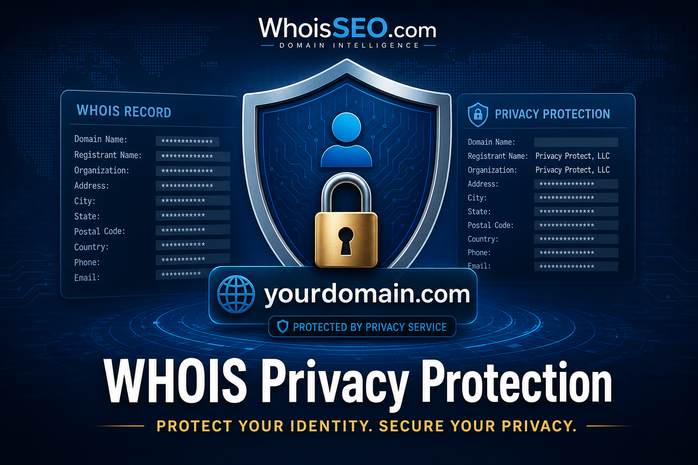
When you register a domain, your contact details are stored in WHOIS—the public registration database behind most TLDs. For years that meant anyone could see a registrant’s name, address, phone, and email. WHOIS privacy protection (also called domain privacy or WHOIS masking) reduces public exposure by replacing your personal data with proxy information from a privacy service.
This guide explains how WHOIS privacy works, what it hides (and what it does not), GDPR redaction, when privacy is worth buying, and how to check any domain on WhoisSEO WHOIS lookup.
What WHOIS contains
Standard WHOIS output may include:
- Registrar and registration dates (created, updated, expiry).
- Domain status flags (clientTransferProhibited, etc.).
- Authoritative name servers.
- Registrant, admin, and technical contacts (name, organization, address, email, phone).
Privacy services and registry policy changes have dramatically reduced visible personal data for many TLDs—especially after GDPR enforcement in 2018.
What is WHOIS privacy protection?
WHOIS privacy is an add-on (often free or low cost) where the registrar or a third-party privacy provider lists their own contact information in public WHOIS instead of yours. Legitimate mail about the domain still reaches you through a forwarding or relay system; abuse and legal notices must be routed per registrar policy.
Privacy is not anonymity from law enforcement or registries—it is protection from casual scraping, spam, and harassment.
Privacy vs GDPR redaction
Many registries now redact personal fields by default for individuals in regulated regions. You may see strings like “REDACTED FOR PRIVACY” without purchasing a separate privacy product. Corporate registrations may still show organization names depending on registry rules.
Privacy add-ons and GDPR redaction overlap in outcome but differ in implementation: privacy services use proxy contacts; redaction removes or masks fields at the registry level.
Can WHOIS data be hidden completely?
Usually partially, not absolutely:
- Hidden from public WHOIS — name, address, email often redacted or proxied.
- Still available to registries/registrars — under contracts and legal process.
- DNS remains public — privacy does not hide A, MX, or NS records.
- Websites still identify you — content, analytics, and legal pages reveal ownership.
Related: can WHOIS data be hidden?
Benefits of enabling WHOIS privacy
- Less spam — scrapers harvest emails from open WHOIS.
- Reduced doxxing risk — home addresses no longer indexed casually.
- Cleaner public footprint — hobby projects and side businesses stay quieter.
- Lower social engineering surface — attackers have fewer personal hooks.
Limitations and trade-offs
- Some ccTLDs do not allow privacy or require local presence.
- Trust-sensitive buyers may prefer transparent ownership for acquisitions.
- SSL validation and some verification workflows may need real data on file with the registrar even if WHOIS is private.
- Privacy does not replace DNSSEC, registrar 2FA, or strong account passwords.
WHOIS privacy vs DNS privacy
Beginners confuse the two:
- WHOIS privacy — masks registration contacts.
- DNS / CDN proxy — hides origin server IP in public A records (e.g. orange-cloud proxy).
- VPN — hides your personal browsing IP from websites you visit—not related to domain WHOIS.
Check live DNS separately with DNS lookup.
How to check if a domain uses privacy
- Run WHOIS lookup on WhoisSEO.
- Look for privacy provider names (e.g. “Withheld for Privacy”, “Domains By Proxy”).
- See if registrant fields show redaction or proxy emails.
- Cross-check creation date and name servers for context.
To investigate ownership despite privacy, read how to find a domain owner using WHOIS and can you trace a website owner?
Should you enable WHOIS privacy?
Yes, for most personal and small business sites unless local law or branding requires public contact. Enable registrar lock and two-factor authentication alongside privacy. For high-value brands, monitor WHOIS for unauthorized changes.
Legal and compliance notes
Registries and registrars must respond to court orders, UDRP domain disputes, and law-enforcement requests. Privacy services forward legitimate legal notices. If you operate in regulated industries (finance, healthcare), consult counsel about whether public contact information is required on your corporate site regardless of WHOIS settings.
How privacy affects domain transfers
Transferring a domain between registrars requires an authorization code and unlocked status. Privacy must not block registrar emails—ensure your account email is current. Temporarily disable privacy only if your registrar documents that requirement; most modern flows work with privacy enabled.
Checking historical WHOIS
Current WHOIS shows today’s data. Investigators sometimes use historical WHOIS archives to see pre-privacy ownership—another reason to keep registration above board for business domains. Pair WHOIS with website history tools for deeper research.
Free vs paid privacy add-ons
Many registrars include basic privacy at no extra cost; others charge annually. Compare total renewal price, not just the first-year promotion. Transferring a domain may reset privacy settings—re-check WHOIS after any registrar migration.
Conclusion
WHOIS privacy protection limits public exposure of registration contact data while keeping your domain fully functional. It does not hide DNS, website content, or your obligations to registries under legal requests. Combine privacy with secure registrar practices and regular WHOIS checks.
Related reading: What is WHOIS lookup? · What is a domain registrar? · Free WHOIS tool