What is a domain registrar? Published: 04 Nov, 2026
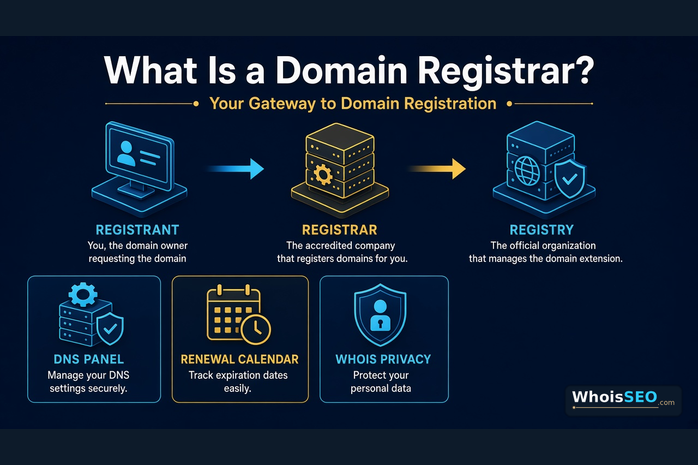
A domain registrar is the company you use to register, renew, transfer, and manage a domain name. When you buy example.com, you do not talk to the top-level domain database directly—you checkout through a registrar that submits your request to the registry, stores your account details, and gives you tools for DNS, locks, privacy, and renewals.
This guide explains what a domain registrar is, how it differs from a registry and a reseller, what services you should expect, and how to verify the registrar of any domain with free WHOIS lookup and DNS lookup tools on WhoisSEO.
If you need the full purchase workflow first, read how domains are registered. For naming basics, see what is a domain name?
Quick answer: what is a domain registrar?
A domain registrar is an accredited (or otherwise authorized) seller of domain registration services. In everyday terms:
- You search for a name and pay the registrar.
- The registrar sends a create, renew, update, or transfer command to the TLD registry.
- You manage the name inside the registrar’s control panel—contacts, nameservers, locks, and invoices.
For generic TLDs such as .com, .net, and .org, registrars that have direct registry access operate under ICANN accreditation and related agreements. Country-code TLDs (ccTLDs) follow their own registry rules; you still buy them through a registrar or authorized retailer, but accreditation labels can differ by country.
Registrar vs registry vs registrant
These three roles are easy to mix up because the words look alike:
| Role | Who it is | What they do |
|---|---|---|
| Registrant | You (person or organization) | Hold the registration rights for the paid term; keep contacts accurate; approve transfers |
| Registrar | Retail account provider | Sell and manage domains, bill renewals, offer DNS/privacy tools, talk to the registry |
| Registry | TLD database operator | Maintain the master list for a TLD, accept registrar commands, publish the TLD zone |
Example: you register harboranalytics.com at Registrar A. Registrar A creates the name in the .com registry. WHOIS later shows Registrar A as the registrar of record—even if your website files live on Host B.
Choosing among extensions is separate from choosing a registrar. Compare endings in difference between .com, .net, and .org.
What a domain registrar actually does
A solid registrar is more than a shopping cart. Typical responsibilities include:
- Availability search and registration — Check whether a label is free under one or more TLDs and submit create requests.
- Billing and renewals — Charge first-year and renewal fees; send reminders; process auto-renew when enabled.
- Contact and account management — Store registrant, admin, and tech contacts the registry and abuse teams may need.
- DNS controls — Let you set nameservers or edit A, AAAA, MX, TXT, CNAME, and NS records. Overview: what are DNS records?
- Security features — Transfer locks, authorization (EPP) codes, two-factor authentication, and recovery emails.
- Privacy / redaction options — Hide personal WHOIS fields where policy allows. Details: WHOIS privacy protection.
- Transfers — Unlock, provide auth codes, and complete inbound or outbound moves between registrars.
- Support and abuse handling — Help with failed renewals, hijack recovery, and legitimate abuse reports.
Many registrars also sell hosting, email, SSL certificates, and website builders. Those extras are optional. Registration alone does not create a website—you still need DNS pointed at real servers.
ICANN accreditation and why it matters
For most gTLDs, an ICANN-accredited registrar is authorized to offer registration services with direct registry access under a Registrar Accreditation Agreement. Accreditation is a compliance and operational standard—not a ranking badge for “best brand.”
Why buyers still care:
- Clear contractual paths for transfers, data escrow expectations, and registrant rights frameworks that apply to many gTLDs.
- A public list of accredited registrars you can cross-check when a brand name looks unfamiliar.
- Accountability: the accredited registrar remains responsible even when a reseller sells under a white-label storefront.
Accreditation does not guarantee the lowest price, perfect uptime, or flawless support. Always read renewal pricing, lock defaults, and DNS limits before you commit a primary brand.
Registrar vs reseller vs hosting “free domain”
Resellers sell registration through an accredited registrar’s backend. Your invoice may show the reseller’s logo, while WHOIS shows the underlying registrar of record. That split is normal—just confirm who can:
- Issue the auth/EPP code
- Toggle transfer lock
- Change the registrant email that receives transfer approvals
Promotional “free domain for 12 months” bundles from hosts are often registrations under a partner registrar. They can be fine for experiments. For a long-term brand, check renewal price after year one, whether the domain can leave the host easily, and whether DNS resets if you cancel hosting.
How to choose a domain registrar
Use practical criteria instead of hype:
- Transparent pricing — Compare renewal, privacy, transfer-in, and redemption fees—not only the first-year promo.
- Security defaults — Prefer registrars that make lock + 2FA easy and keep recovery options under your control.
- DNS flexibility — You should be able to point nameservers to Cloudflare, your host, or any DNS provider.
- Transfer friction — Auth codes should be available without multi-week delays for unlocked, eligible names.
- Support quality — Test documentation and ticket response before you park a portfolio there.
- Account ownership — Register under the company (or a durable role email), not a contractor inbox you may lose.
- TLD coverage — Confirm the registrar supports the extensions you need, including relevant ccTLDs.
For brand-fit naming before checkout, use how to choose a professional domain name.
What you see in WHOIS for a registrar
A WHOIS or RDAP response usually includes a registrar field (and often a registrar IANA ID for many gTLDs). That field answers: “Which company currently manages this registration account?”
It does not by itself tell you:
- Where the website is hosted
- Who wrote the page content
- Whether email is secure
- Google ranking potential
Hosting and mail live in DNS. After you note the registrar, run a DNS lookup for A/AAAA, MX, NS, and TXT. Privacy may hide registrant contacts while still showing the registrar—see WHOIS privacy protection.
Registrar services that affect day-to-day operations
Nameservers and DNS hosting
Some registrars host DNS by default; others expect you to bring external nameservers. Either model works. Problems start when teams assume “I registered it, so the site should load” without publishing records. Beginner context: simple explanation of DNS for beginners.
Transfer lock and auth codes
Leaving lock off on a valuable brand invites unauthorized transfer attempts. Leaving lock on during a planned move blocks a legitimate transfer. Good registrar hygiene: lock by default, unlock only when moving, then lock again.
Auto-renew and expiry
Registrars bill renewals; registries extend expiry when renewals succeed. Failed cards and suspended accounts still cause drop risk. Monitor expiry in WHOIS monthly for critical names—creation and expiry fields are among the most useful operational signals.
Privacy and accurate contacts
Privacy can redact public WHOIS fields, but the registrar still needs a reachable contact for renewals, abuse, and recovery. Fake data can delay help when you need it most.
Common myths about domain registrars
- “The registrar owns my domain forever.” No. You hold rights for the paid term and successful renewals. Miss lifecycle windows and others can register the name later.
- “Any company with ‘domains’ in the logo is accredited.” Not always. Check WHOIS registrar of record and, for gTLDs, public accreditation listings when unsure.
- “Moving hosts means I must change registrars.” False. You can keep the registrar and only change nameservers or A records.
- “Cheapest first year is always best.” Renewal and redemption pricing matter more for brands you keep.
- “Registrar choice ranks me in Google.” Search quality depends on content and technical health far more than which retail panel you use. Related: does domain affect SEO?
How to check a domain’s registrar on WhoisSEO
- Open https://whoisseo.com/whois.
- Enter the root domain (for example
example.com), not a full URL path. - Read the registrar field and note creation date, expiry, status flags, and listed nameservers.
- If you plan a purchase or migration, confirm lock/status is not in hold or redemption.
- Run DNS lookup to see whether the name currently resolves for web and email.
When WHOIS shows an unexpected registrar change, treat it as an incident: verify account access, re-enable lock, rotate credentials, and contact support immediately.
Practical checklist before you trust a registrar with a brand
- Enable 2FA and store recovery codes offline.
- Use a company-owned recovery email and phone.
- Turn on transfer lock after every successful create or inbound transfer.
- Document who on the team can approve transfers.
- Calendar the expiry date even if auto-renew is on.
- Export a list of production domains and their registrars quarterly.
- Separate speculative domains from crown-jewel brands when useful.
FAQ: what is a domain registrar?
Is a domain registrar the same as a web host?
No. A registrar manages the domain registration. A host runs website files or applications. One company may sell both, but the services are different.
Do I need an ICANN-accredited registrar?
For many gTLDs, registration with direct registry access goes through ICANN-accredited registrars (or their resellers). For ccTLDs, follow the rules of that country’s registry. In all cases, buy from a reputable, authorized channel.
Can I change registrars later?
Yes, through a domain transfer (unlock, auth code, approve at the gaining registrar), subject to locks, recent registration windows, and TLD policy. Re-check nameservers after the move.
Why does WHOIS show a different company than the website I bought from?
You may have purchased through a reseller or white-label partner. WHOIS typically shows the registrar of record that holds the accreditation relationship.
Does the registrar control my DNS forever?
Only if you leave nameservers on their DNS. You can point NS records to another provider at any time without transferring the registration.
What should I do if I lose registrar account access?
Use official account recovery with proof of control. Keep registrant contacts accurate before emergencies. WhoisSEO can show the registrar name; recovery still happens with that registrar’s support process.
Conclusion
A domain registrar is your retail gateway to the domain name system: the company that registers and renews names, coordinates with the TLD registry, and provides the account where locks, DNS, privacy, and transfers are managed. Pick registrars for clear pricing, strong account security, and flexible DNS—not slogans. Before you buy, migrate, or investigate a name, confirm the registrar of record with WhoisSEO’s free WHOIS and DNS tools.
Related reading: How domains are registered · What is a domain name? · .com vs .net vs .org · WHOIS privacy · DNS records