What is an IP address? Published: 18 Jun, 2026
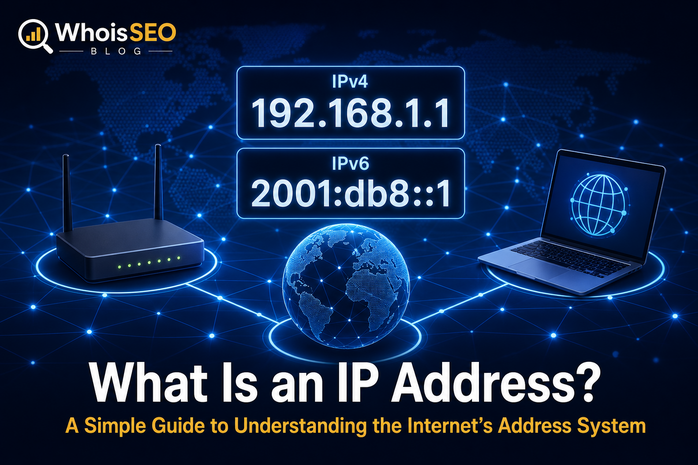
An IP address (Internet Protocol address) is a unique identifier assigned to every device that communicates on an IP network—including the internet. When you visit a website, send email, or stream video, packets carry source and destination IPs so routers know where to deliver them.
This beginner-friendly guide explains IPv4 vs IPv6, public vs private addresses, how ISPs assign IPs, and how to look up any address with WhoisSEO IP lookup.
Why IP addresses exist
Networks need a consistent addressing scheme. Humans prefer domain names; routers require numeric endpoints. DNS bridges the gap by resolving names to IPs (DNS explained).
IPv4 structure
IPv4 uses 32 bits, written as four decimal octets: 192.0.2.1. Only about 4.3 billion addresses exist—insufficient for every phone, server, and IoT device worldwide. NAT (Network Address Translation) and private ranges slowed exhaustion but did not eliminate it.
Private IPv4 ranges (RFC 1918)
10.0.0.0 – 10.255.255.255172.16.0.0 – 172.31.255.255192.168.0.0 – 192.168.255.255
These addresses are not routable on the public internet—they appear inside homes and offices behind a router.
IPv6 structure
IPv6 uses 128 bits, written in hexadecimal groups: 2001:db8::1. The space is vast, enabling end-to-end addressing without NAT in ideal cases. Adoption grows steadily; many networks run dual-stack (IPv4 + IPv6).
Compare: IPv4 vs IPv6 differences.
Public vs private IP addresses
- Public IP — reachable on the internet; assigned by ISPs or cloud providers.
- Private IP — internal only; your laptop’s
192.168.x.xWi‑Fi address.
Websites see your public IP, not your private LAN address. VPNs replace the public IP seen by remote servers.
Static vs dynamic IPs
Dynamic IPs change periodically—typical for residential broadband. Static IPs stay fixed—common for servers, business lines, and some APIs that whitelist addresses. Read static vs dynamic IP.
How ISPs assign IP addresses
Internet Service Providers receive large blocks from regional registries (RIPE, ARIN, APNIC, etc.) and delegate addresses to customers via DHCP or PPPoE sessions. Mobile carriers often use carrier-grade NAT, meaning many users share one public IPv4.
More: how ISPs assign IPs and what is an ISP?
IP addresses vs MAC addresses
A MAC address identifies hardware on a local Ethernet/Wi‑Fi segment. IPs can change as you move networks; MACs (usually) stay with the network interface. Routers map IPs to MACs using ARP on local LANs.
What IP lookup reveals
IP geolocation estimates location, ISP, ASN, and sometimes usage type (hosting, mobile, corporate). Accuracy varies—city level is common; street level is rare without other data.
Try free IP lookup and how IP geolocation works.
Security and privacy
Your IP is not a secret—it must be exposed to servers you contact. It can reveal coarse location and provider but not your name directly. Law enforcement may correlate IPs with subscriber records from ISPs under legal process.
VPNs, Tor, and proxies mask the IP seen by websites—see what is a VPN?
Common misconceptions
- “My IP is my exact home address” — usually false; geolocation is approximate.
- “Private IP appears in server logs” — remote sites see your public IP.
- “IPv6 is always more private” — IPv6 can be stable and traceable if not managed.
Special-use and documentation ranges
RFCs reserve blocks such as 192.0.2.0/24 (TEST-NET-1) for documentation—like addresses in this article. Packets should not appear on the public internet. Cloud providers also publish well-known metadata IPs (e.g. AWS 169.254.169.254) for instance information inside VPCs only.
IP address exhaustion and carrier-grade NAT
Because IPv4 addresses are scarce, many mobile carriers place thousands of subscribers behind shared public IPs using CGNAT. That makes IP-based blocking or geolocation less precise for cellular users and explains why mobile fraud scores often differ from desktop broadband.
FAQ: IP address basics
Can two devices share one public IP? Yes—NAT and CGNAT map many devices to one address.
Why does my IP change overnight? Dynamic DHCP leases from ISPs renew periodically.
Is my IP personal data? Under GDPR it can be, when linkable to an identifiable subscriber.
How do I find my public IP? Use WhoisSEO IP lookup without VPN connected.
IP addressing in home and office networks
Your router performs DHCP to assign private IPs to phones and laptops. When those devices browse the web, the router replaces the private source with one public IP using NAT. Port forwarding rules map incoming public ports to internal servers for self-hosting games or cameras—misconfiguration exposes LAN services. IPv6 may assign a global address to each device, changing firewall assumptions; enable router firewall rules regardless of protocol version.
Cloud VMs receive public or elastic IPs from hyperscalers—document these in runbooks for API allowlists and DNS A records.
Understanding addressing fundamentals makes DNS, firewalls, and IP lookup reports far easier to interpret when troubleshooting production issues.
Conclusion
An IP address is the fundamental locator for internet traffic—IPv4 today, increasingly IPv6 tomorrow. Understand public vs private, static vs dynamic, and use lookup tools responsibly for security research, abuse handling, and network debugging.
Related: How IP lookup works · What is GeoIP? · IP lookup tool